
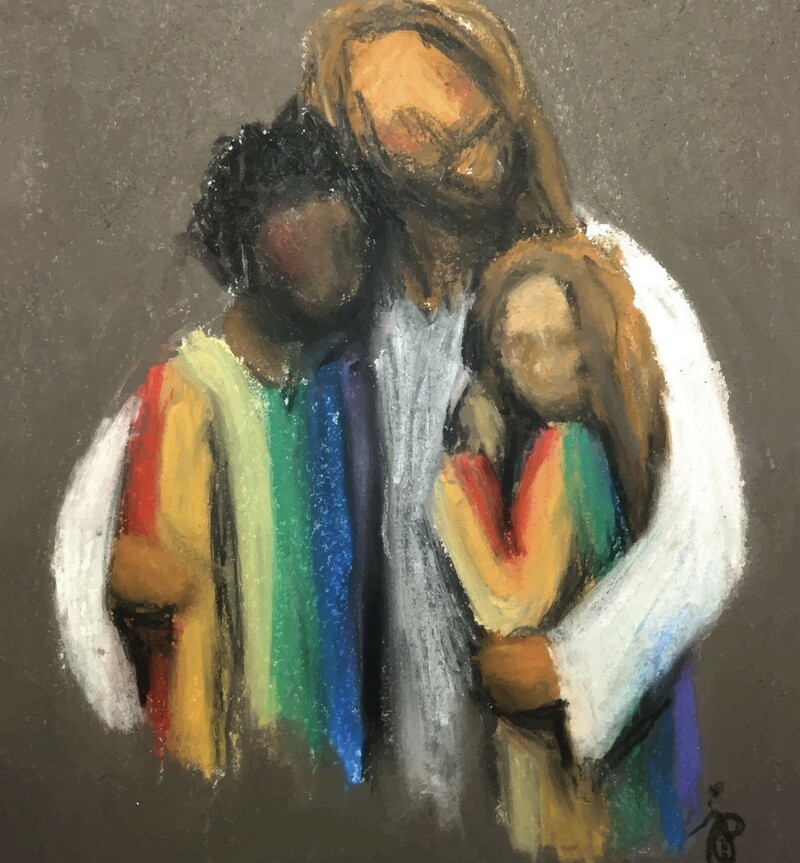
Pentecost 3, Year A, Track 2
Exodus 19:2-8a (and Genesis 18:1-15, 21:1-7)
Psalm 100
Romans 5:1-8
Matthew 9:35-10:23
As I was reading this Sunday's passages over the past week, I couldn't help but laugh a little at the timing. This is the only time this month that I am preaching, and right at this moment, a few blocks from my home, people are gathering in Southside Park for a special Eucharist to kick off the Sacramento Pride Parade. So of course it is today, of all days, that our Gospel evokes an image that all LGBT people—and especially LGBT Christians—have grown up dreading: Sodom and Gomorrah.
Sodom and Gomorrah is the most enduring cudgel in our faith context for the supposed wrongness of LGBT people. The story from Genesis is vivid and terrifying. Two great, prosperous cities, full of decadence and debauchery, struck from the earth by God's terrible wrath. It has leached into our cultural fabric to the point that "sodomy" is the name given to the crime of being gay in more than sixty countries worldwide today. In as many as a dozen of those countries, the sentence for that crime can still be death. In our own country, I was nearly in high school, and struggling to understand my own sexuality, by the time the Supreme Court finally struck down the last remaining state sodomy statutes.
Over generations, the Church has done profound damage to those who would not conform to its expectations of gender and sexuality, especially to those who internalized the message that they were fundamentally broken, lesser, twisted people, at best deserving of pity and at worst deserving of violent rejection. I grew up internalizing that, hating myself, desperate to be fixed, angry that God had rejected my prayers to make me better. It has taken decades for me to understand that I did not need fixing, and I am not still fully healed from that emotional violence inflicted upon me by others, and which I inflicted upon myself believing that was what God wanted.
But as painful as it is for me to do, today I want to take a closer look at Sodom and Gomorrah, and at why, of all the images Jesus could have reached for to make his point, he chose this one.
Our passage from Matthew begins with Jesus surveying his corner of the world and finding a great deal of work that needs doing. "The harvest is plentiful," he says, "but the laborers are few." And so he gives his disciples authority to cure disease and to cast out demons. It’s important to note, Matthew’s Gospel generally uses two Greek words that we can understand as “power” or “authority.” The first is dynamis, the root of our word "dynamite." It is raw force or energy. When we picture this moment, we might imagine some mystical transfer of power crackling from Jesus into the disciples. But the word Matthew actually uses here is not dynamis. It is exousia. Exousia is a more abstract idea, but one well understood in Jesus' time as a political concept. Pontius Pilate embodied the whole exousia of the Roman Empire—its symbolism, legitimacy, and power—in his office as governor. Jesus is not licensing the disciples or letting them borrow his power. In the Greek understanding, exousia given becomes the recipient's own. The power Jesus gave them was now genuinely theirs, an authority from which they themselves could do these seemingly impossible things.
Then Jesus gives them their instructions, and on a casual reading, some of them don't sound much like the Jesus we think we know. First he tells them, "Go nowhere among the Gentiles, and enter no town of the Samaritans, but go rather to the lost sheep of the house of Israel." But Jesus is not shutting the Gentiles and the Samaritans out of his ministry. He is a healer triaging his patients, and the house of Israel is the one most desperately in need of good news and newness of life.
He goes on: "Whatever town or village you enter, find out who in it is worthy, and stay there until you leave. As you enter the house, greet it. If the house is worthy, let your peace come upon it; but if it is not worthy, let your peace return to you." Our modern ear can easily mishear the word worthy. Jesus is not telling his disciples to seek out the most upstanding, highly-esteemed people in town. The word translated "worthy" is the Greek axios, which in its most literal sense describes the balance of two things on a scale. Jesus wants his disciples to find the people with open hearts—the ones willing to really listen—rather than waste themselves butting heads with those who are determined not to.
And then, finally, we come to it: "If anyone will not welcome you or listen to your words, shake off the dust from your feet as you leave that house or town. Truly I tell you, it will be more tolerable for the land of Sodom and Gomorrah on the day of judgment than for that town." Why Sodom and Gomorrah? Why this particular comparison, in this particular place in the Gospel?
Our first clue is in the alternate Old Testament reading appointed for today, from Genesis 18. Abraham "looked up and saw three men standing near him. When he saw them, he ran from the tent entrance to meet them, and bowed down to the ground. He said, 'My lord, if I find favor with you, do not pass by your servant. Let a little water be brought, and wash your feet, and rest yourselves under the tree. Let me bring a little bread, that you may refresh yourselves.'" Abraham lays out a feast for these strangers, who in turn announce to him that his aged wife Sarah will bear a son.
After that joyous news, the men set out for Sodom at God's direction, and arrive in the evening. Lot is the first to greet them. "When Lot saw them, he rose to meet them and bowed down with his face to the ground. He said, 'Please, my lords, turn aside to your servant's house and spend the night and wash your feet.'" Lot prepares them a feast, exactly as Abraham had. But then things take their terrible turn. The men of the city gather at Lot's house and demand that he bring his guests out to them, so that they may "know them." Lot pleads with the mob to leave his guests alone, bargaining for their dignity and safety.
It is the implication of what the men of Sodom intend to do to those guests that became the root of the erroneous notion that the sin of Sodom is a sin of sexuality. But to accept that premise, we have to do two things. First, we have to equate sexual violence in the ancient world—a weapon of domination and humiliation wielded here against the outsider—with consensual love between people in the modern world. And then we have to turn a blind eye to the rest of the story in Genesis 18 and 19, and to the plain explanation the prophet Ezekiel gives when God admonishes Jerusalem for similar sins: "This was the guilt of your sister Sodom: she and her daughters had pride, excess of food, and prosperous ease, but did not aid the poor and needy."
Now look back at what Jesus is doing in our Gospel. He is sending his disciples out to be the strangers at the town gate. He sends them with no money, no spare clothes, not even sandals—reliant entirely on the kindness and generosity of whoever they meet along the way. They are Abraham's three visitors now, the men who arrive at Lot's door in the evening. Every town the disciples enter faces the same test Sodom faced: will it open the door to the vulnerable stranger, or slam it shut?
Now we can understand the allure of the inaccurate presumption about the sin of Sodom and Gomorrah. The Church and the institutions of our culture and government worked for generations to make these leaps of understanding feel natural and obvious, and whether anyone intended it or not, the effect was always the same: to deflect the guilt. Because if the sin of Sodom is being gay, then the vast majority of us are safe. But if the sin of Sodom is what Scripture plainly says it is—prosperous people showing callous indifference to the needy and hostility to the stranger—then the indictment swings another way, towards far more of us. So we reached for the reading that pointed away from the majority. We took the name of the city that turned the needy away, and hung it around the necks of the very people that we were turning away.
This time of year I still often think of the boy I used to be, praying to be made into someone else, certain that God was on the far side of a door that would never open until I had fixed whatever was broken in me. And I still often think of the disciples in my life who healed me—not from what I imagined to be my sickness, but from the burden of hating who I am. They gave me laughter like Sarah’s, delight at the sheer impossibility that I could be so loved, so valued, so worthy. And I still laugh inside that today of all days, I am talking about Sodom and Gomorrah.
In Southside Park right now, in the creeping heat of the late morning, a feast is being laid out. It is a feast for all, but especially for those afraid to go to the places this feast is usually offered. A sacrifice is made, the one perfect sacrifice for all people, in all places, for all time. Grace pours forth, cascading from one heart to the next, and strangers now are friends, and all are God’s treasured possession. Amen.